
How to avoid race condition in shared resources in Java?

Sharing resources between threads can be a challenging task, as it requires ensuring that operations are atomic.
What is a resource?
A resource can be variables, data structures, files, messages, etc.
In Java, we have two important memory areas: the Stack and the Heap.
- The stack memory stores local primitive types, local references, and does not share resources.
- The heap memory stores objects, class members, static variables, and does share resources.
Why use shared resources between threads?
There are many reasons, but a common example is an event emitter that publishes messages to a queue, while multiple threads listen to the queue to process the events.
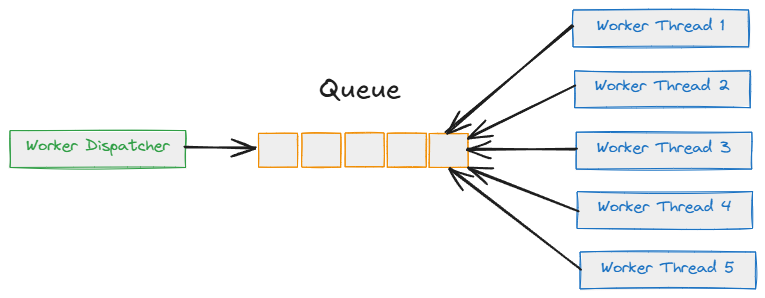
This means that the Queue (a data structure stored in the heap memory) is a shared resource between threads. This enables efficient CPU usage and allows for low latency, as there’s no need to create a new thread for every new event.
Another example is making HTTP requests in different threads. Imagine a scenario with 5 HTTP requests, and each response populates a Java List — in this case, the List is a shared resource. There’s even a post explaining how to make HTTP requests in multiple threads in Java if you’re interested.
Hands on

In the following example, we simulate a company’s stock management system, where we can increment (when the company receives products) or decrement (when the company sells products) the stock count.
public class MainProblem {

    public static void main(String[] args) throws InterruptedException {
        InventoryCounter inventoryCounter = new InventoryCounter();
        IncrementingThread incrementingThread = new IncrementingThread(inventoryCounter);
        DecrementingThread decrementingThread = new DecrementingThread(inventoryCounter);

        incrementingThread.start();
        decrementingThread.start();
        incrementingThread.join();
        decrementingThread.join();

        System.out.println(inventoryCounter.getItems());
    }

    public static class DecrementingThread extends Thread {
        private InventoryCounter inventoryCounter;

        public DecrementingThread(InventoryCounter inventoryCounter) {
            this.inventoryCounter = inventoryCounter;
        }

        @Override
        public void run() {
            for (int i = 0; i < 100000; i++) {
                inventoryCounter.decrement();
            }
        }
    }

    public static class IncrementingThread extends Thread {
        private InventoryCounter inventoryCounter;

        public IncrementingThread(InventoryCounter inventoryCounter) {
            this.inventoryCounter = inventoryCounter;
        }

        @Override
        public void run() {
            for (int i = 0; i < 100000; i++) {
                inventoryCounter.increment();
            }
        }
    }

    private static class InventoryCounter {
        private int items = 0;

        public void increment() {
            items++;
        }

        public void decrement() {
            items--;
        }

        public int getItems() {
            return items;
        }
    }

}
It demonstrates a race condition problem: two threads accessing and modifying a shared variable (items) without proper synchronization.
🧠 What does this Java code illustrate?
✅ Objective:
Create two threads:
- One thread increments
items100,000 times. - Another thread decrements
items100,000 times.
The final value of items should be 0 — since the increments and decrements cancel each other out.
🔍 Analysis by parts:
1. MainProblem Class
InventoryCounter inventoryCounter = new InventoryCounter();
Creates an instance that contains the inventory counter.
IncrementingThread incrementingThread = new IncrementingThread(inventoryCounter);
DecrementingThread decrementingThread = new DecrementingThread(inventoryCounter);
Creates both threads, passing the same InventoryCounter object.
incrementingThread.start();
decrementingThread.start();
Starts threads in parallel.
incrementingThread.join();
decrementingThread.join();
Wait for both threads to finish.
System.out.println(inventoryCounter.getItems());Displays the final result of items.
2. InventoryCounter class
private int items = 0;
Item counter shared between threads.
public void increment() { items++; }
public void decrement() { items--; }
Increment and decrement methods are not synchronized, i.e. they are not thread-safe.
3. IncrementingThread and DecrementingThread class
Each one calls increment() or decrement() 100,000 times:
for (int i = 0; i < 100_000; i++) {
    inventoryCounter.increment(); // ou decrement()
}
❗ Problem
The operations items++ and items-- are not atomic. Each consists of:
- Reading the value from memory,
- Modifying it (add or subtract 1),
- Writing it back to memory.
If two threads perform these steps simultaneously, they may overwrite each other’s changes — resulting in incorrect outcomes like:
- -13264;
- 5009;
- 5552;
- -4298;
- 18828.
✅ How to fix it?
1. Use synchronized methods:
 public synchronized void increment() {
      items++;
  }

  public synchronized void decrement() {
      items--;
  }
2. Use synchronized blocks:
private static class InventoryCounter {

      Object lock = new Object();
      private int items = 0;

      public void increment() {
          synchronized (this.lock) {
              items++;
          }
      }

      public void decrement() {
          synchronized (this.lock) {
              items--;
          }
      }

      public int getItems() {
          synchronized (this.lock) {
              return items;
          }
      }
  }
Instead of marking the entire method as synchronized, the synchronized block is applied only to the critical section, that is, the piece of code that actually needs to be thread-safe.
✅ Advantages:
- More control: You decide exactly what gets protected by synchronization.
- Potentially better performance: Only the necessary code is locked, freeing up the rest of the execution.
- Avoid synchronizing simple read methods that don’t need to be synchronized completely.
🧱 Comparison with synchronized in the method
public synchronized void increment() {
    items++;
}
➡️ Blocks the entire method, even if it does several things besides items++.
public void increment() {
    synchronized (this.lock) {
        items++;
    }
}
➡️ Blocks only the critical part, which is item modification.
Use synchronized (lock):
- It is more flexible and controlled than synchronizing the entire method.
- Allows you to synchronize multiple blocks independently.
- It is a best practice in more complex situations where performance and modularity matter.
For small didactic examples, synchronizing the method may be sufficient. But in real production code, using synchronized blocks with a separate lock object is a safer and more scalable approach.
3. Use AtomicInteger:
private static class InventoryCounter {
      private AtomicInteger items = new AtomicInteger(0);

      public void increment() {
          items.incrementAndGet();
      }

      public void decrement() {
          items.decrementAndGet();
      }

      public int getItems() {
          return items.get();
      }
  }
Conclusion
This code shows how to and how not to manipulate variables shared between threads. It is excellent for educational purposes and shows in a practical way the importance of concurrency control.